
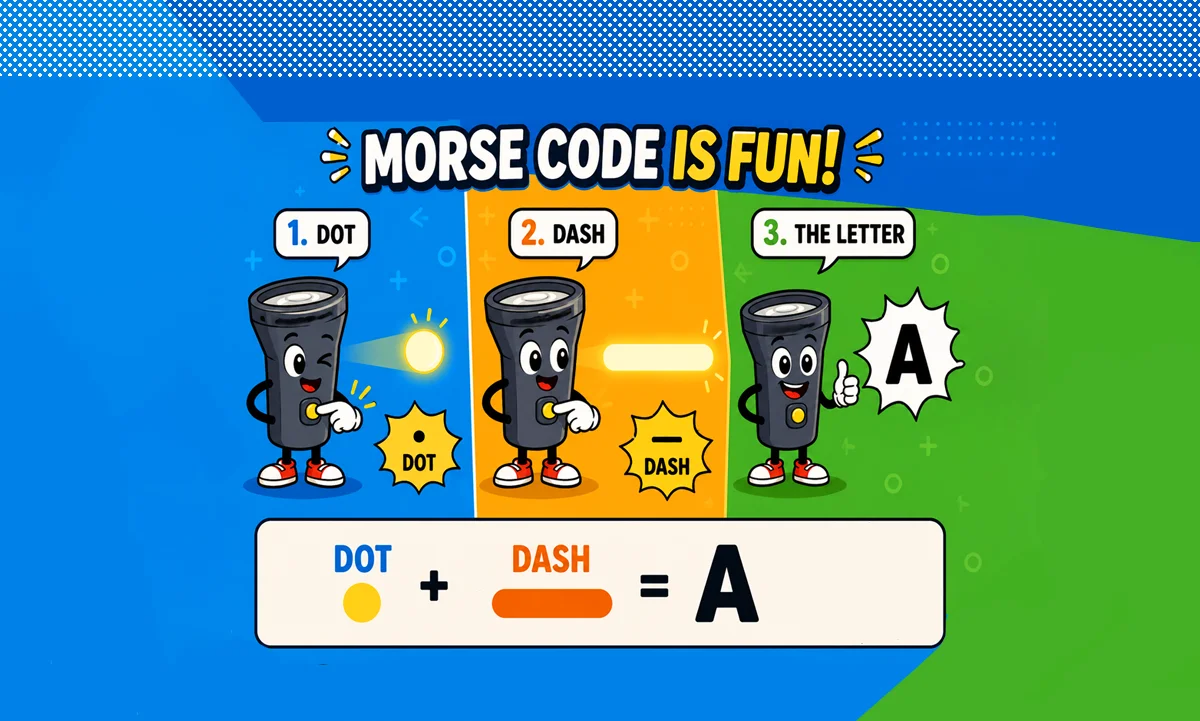
The letter A in Morse code is one dot followed by one dash: · −
That is it — two symbols. Yet there is more to this simple pattern than most people realize, from why Samuel Morse and Alfred Vail designed it that way to how you can still use it today.
What does A look like in Morse code?
A in Morse code is written as dot-dash (· −). When you tap it out, it sounds like a short beep followed by a long beep: dit-dah. Once they memorized it, 1800s telegraph operators could transmit this in less than a second.
| Letter | Morse code | Sound |
|---|---|---|
| A | · − | dit-dah |
Letter A - International Morse Code
· −
This pattern shows up everywhere once you know it. Ships have flashed it with lights. Soldiers have sounded it out on metal pipes. Prisoners have used it to communicate through walls.
Why is A just one dot and one dash?
The code was designed around frequency. Morse and his assistant Alfred Vail followed a principle similar to Huffman coding: more frequently used letters received shorter codes. E, the most common letter in English, is a single dot. A gets the second-shortest pattern because it appears constantly — and at the beginning of thousands of common words.
This was not guesswork. Letter counts were reportedly based on printer type cases - whichever bins ran empty fastest told them which characters to compress. That is how the efficiency of the code came about.
How to remember A in Morse code
Most people learn Morse through rhythm, not rote memorization. For A, say “about” aloud and emphasize the second syllable: short, then long. That is the dit-dah pattern.
TipVisual memory aid
Think of the letter A itself — a short stroke and a long slanted line. Repetition is what makes it permanent, whatever method sticks. Fifty taps and you will not forget it.
A in Morse code vs other letters
It helps to see A next to letters it is easy to confuse:
| Letter | Morse code | Notes |
|---|---|---|
| A | · − | dot, dash |
| N | − · | dash, dot — the reverse of A |
| U | · · − | dot, dot, dash |
| W | · − − | dot, dash, dash |
Ntrips people up the most because it is A's mirror image. Get the order backward and you have sent a completely different letter.
Where A in Morse code is used today
Morse code is not dead. This mode can travel farther and is still used because weak signals are easier to decode than voice:
- Amateur radio operators send individual letters and full messages by key
- Pilots and air traffic controllers occasionally identify navigation beacons by Morse
- Search and rescue teams use it as a backup when radios fail
- Training drills combine single letters like A with distress signals such as SOS
Quick reference chart
| Symbol | Meaning |
|---|---|
| · | dot (dit) |
| − | dash (dah) |
| · − | Letter A |
FAQ: A in Morse code
- What is A in Morse code?
- A in Morse code is one dot followed by one dash (· −), spoken as “dit-dah.”
- How do you write A in Morse code?
- Write it as a short mark followed by a long mark: · −. In text form, it is often shown as “.-”.
- How do you say A in Morse code?
- Say it as “dit-dah,” with the second sound held about three times longer than the first.
- What is the opposite of A in Morse code?
- N is the reverse of A. N is dash-dot (− ·), while A is dot-dash (· −).
- Why is A a short code in Morse?
- Because A appears frequently in English, especially at the start of words, Morse code assigns it a short pattern to make transmission faster.
- Is A in Morse code the same in every language?
- International Morse code uses the same pattern for A across most languages that use the Latin alphabet. Some older regional variants, like American Morse code from the 1840s, used slightly different timing.
- Can I use a flashlight to send A in Morse code?
- Yes. A short flash followed by a longer flash sends the letter A. This works with lights, sound, or even taps on a surface.
Type A in our free Morse code translator to hear the dit-dah rhythm, or browse the full Morse code alphabet guide for every letter.