
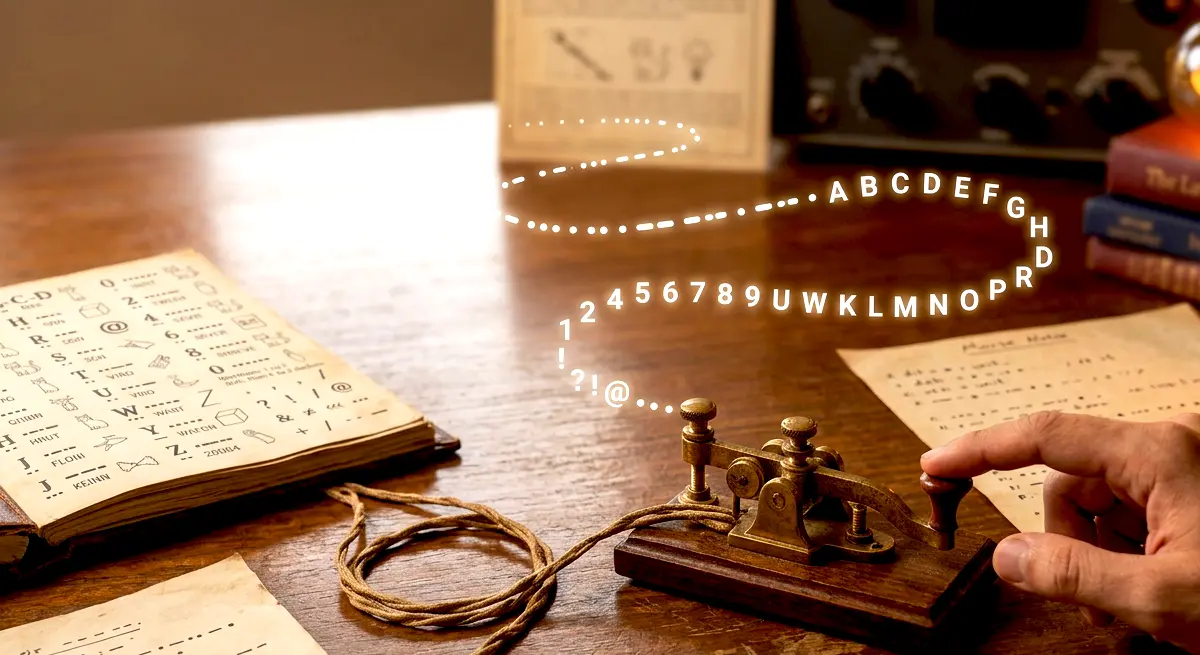
International Morse Code has a system of short signals and long signals, where dots (dit) and dashes (dah) represent letters, numbers, and punctuation. A dah is exactly three times longer than a dit. It is a globally used standard formalised by the International Telecommunication Union (ITU) and used by amateur radio operators, maritime services, and emergency communications.
The Morse Code Alphabet (A–Z)
There are shorter and longer codes for each letter, with the more common letters (E, T, A, I, N, O, S, H) assigned to short codes — this was intentional, based on frequency of occurrence in English text.
Numbers 0–9
Numbers follow a very logical order: 1 has just one dot, 2 adds another dot, and so on up to 5. From 6 onward, dashes appear at the beginning of the pattern and increase toward 0 (five dashes for zero).
Punctuation & Prosigns
Beginners tend not to memorize punctuation marks and procedural signals (prosigns), although they are necessary for complete written communication, as well as operation over the radio.
Timing Rules
Morse code timing is everything. These ratios are benchmarked by the ITU:
- 1 dit = 1 unit
- 1 dah = 3 units
- Distance between signals in a letter = 1 unit
- Gap between letters = 3 units
- Gap between words = 7 units
At 20 WPM (words per minute), one unit is approximately 60 milliseconds. The word used for WPM calculation is “PARIS” — 50 units long, including the trailing space.
The First Letters to Learn
If you are a beginner, here is an ordering of high-frequency letters in English text:
E · T − A ·− I ·· N −· O −−− S ··· H ····
These 8 letters alone represent about half of characters in regular written English text — meaning that learning them first gives you the highest return for time spent practicing.
Tips for Memorization
- Mirror pairs: N (−·) is a mirror of A (·−). K (−·−) mirrors R (·−·). Learning them in pairs halves the memorization task.
- Signal count: E = 1, I = 2, S = 3, H = 4. T = 1, M = 2, O = 3.
- Learn by sound:Don't fixate on the chart — hear each character played at tempo and train your ear to recognize it without conscious thought.