
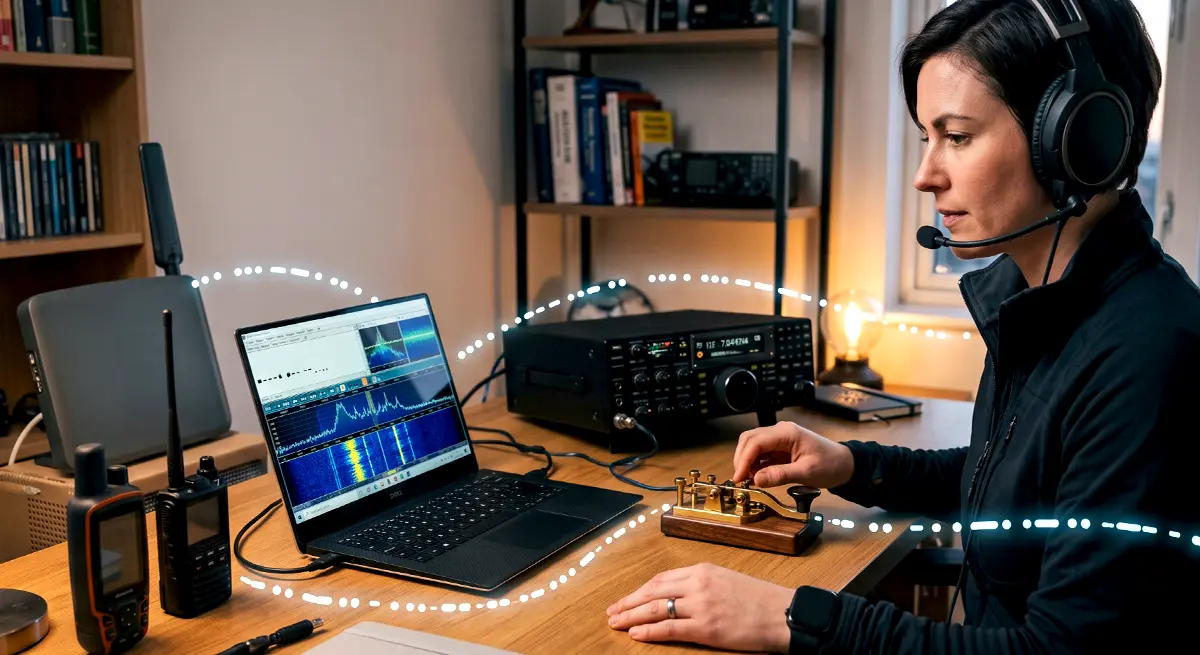
The very last commercial maritime Morse station closed in 1999, and for most people the technology seemed destined to become a part of history. That prediction turned out to be completely off base. And, despite this proclivity to die out, Morse code has quietly persisted — and even expanded into the 21st century in some areas. And here are 10 of the places you'll see it being used today.
1
Accessibility and Assistive Technology
Morse code is still used in a few varieties today, most notably for helping folks with motor disabilities to communicate. Morse input with dot and dash is supported via two switch inputs on Google's Gboard keyboard, meaning smartphones are usable by those who can't type in a conventional manner. Some eye-tracking systems can decode blinks as Morse signals. For those suffering from locked-in syndrome or ALS, Morse code could represent the difference between silence and communication.
2
Amateur (Ham) Radio
More than 3 million licensed amateur radio operators around the globe still utilize Morse code (called CW, for Continuous Wave) regularly. CW can penetrate interference and weak signal conditions that are fatal to voice communications, making it ideal for long-distance contacts or emergency nets. The International Morse Code Preservation Society actively promotes its use.
3
Military Survival Training
In the United States, the UK, and many other nations' military forces still instruct personnel in Morse code as part of survival training (SERE — Survival, Evasion, Resistance, Escape). A downed pilot armed only with a flashlight or stone can send SOS signals. Morse is irreplaceable in survival, as no fancy machines are required — its simplicity and reliability speak for themselves.
4
Aviation Navigation: NDBs and VORs
Today, the identifiers of Non-Directional Beacons (NDBs) and VOR (VHF Omnidirectional Range) aviation stations transmit in Morse code as well. Pilots confirm that they're locked into the right navigational beacon by listening for its Morse ID. While GPS has reduced reliance on these beacons, they are still in use across the world and remain part of instrument flight training.
5
Emergency Communications
In disasters where phone networks, cellular towers, and internet infrastructure collapse, amateur radio operators using Morse code are often the only reliable communication link. Morse is low-power (a tiny battery can power a small transmitter for hours), propagates thousands of miles, and works well in heavy noise. Emergency planning frequently involves CW operators through organizations like FEMA and ARES (Amateur Radio Emergency Service).
6
Covert and Intelligence Operations
Although Morse code is no longer the primary method of communication, intelligence agencies and special operations forces still train personnel on how to use it for discreet communication. A single agent with a small transmitter can send compressed Morse bursts that are much more difficult to intercept or triangulate than voice. Morse was used by spy networks in the Cold War, and although classified, many believe it is still implemented today.
7
Hostage and Prisoner Signaling
Vietnam War POWs used the code they called “Tap Code” at the Hanoi Hilton, based on Morse principles. Prisoners tapped messages through cell walls using a 5×5 grid of letters. More directly, there are reports of hostages blinking Morse code messages to cameras during video statements — a behavior now trained for and tracked by intelligence analysts.
8
Lighthouse Identification
Many lighthouses around the world identify themselves to mariners today by light-flash patterns, many of which are directly derived from Morse code letter sequences. A lighthouse flashing “· − −” repeats the letter W, which those familiar with Morse recognize — offering sailors an alternative to GPS and chart plotters when identifying a particular tower.
9
Education and Cognitive Training
Educational research uses practice in Morse code as a proxy for language acquisition, pattern recognition, and auditory processing. A handful of studies have investigated Morse code as a form of cognitive training for older adults. It is more than a communication skill: its structured learning and rhythm-based progression stimulates multiple areas in the brain at once.
10
Pop Culture and Puzzles
Movies, TV shows (The Walking Dead; Stranger Things), video games, escape rooms, and ARGs have all featured the use of Morse tones. It is widely known, but it takes effort to decode — which is why puzzle designers use it. It has also become a favorite for tattoos, jewelry, and art projects — people encode important words or dates in the dot-dash pattern.
The Takeaway
One of the reasons Morse code has survived is because it is beautiful: a binary system (on/off, dit/dah) that can be transmitted over any channel capable of carrying a signal — light, sound, electrical current, or touch. In a complicated world of digital systems, that simplicity is not a weakness. It's a feature that preserves Morse code's relevance nearly 200 years after its invention.