
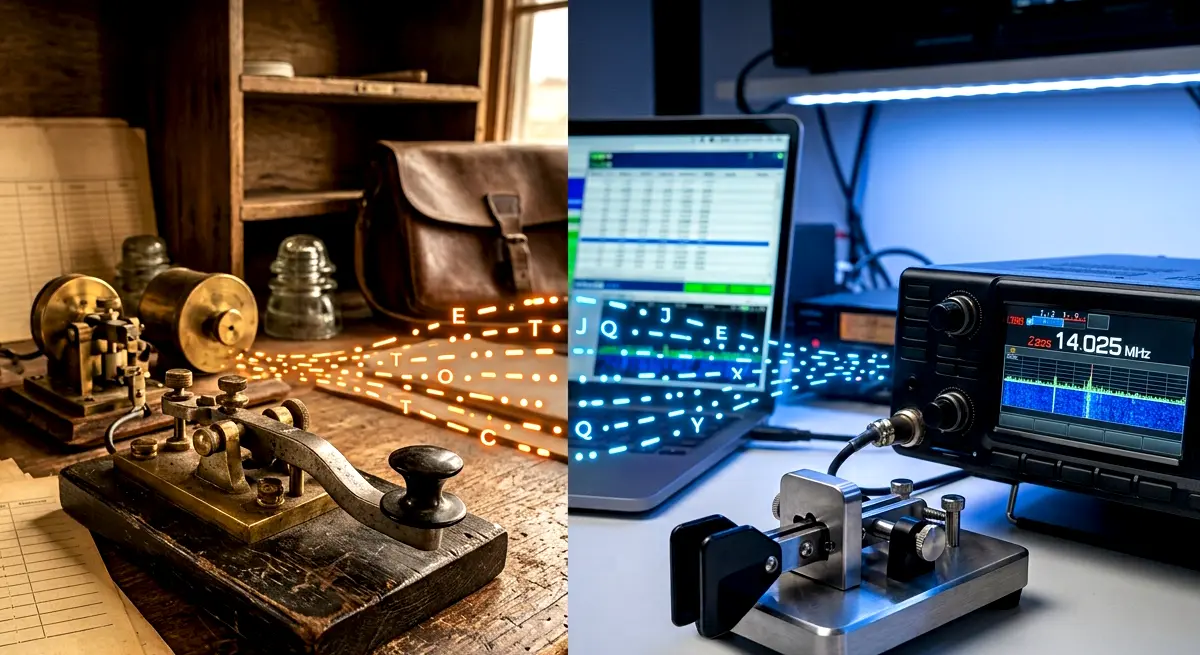
The most common Morse code you will see today is a standard called International Morse. However, there are in fact two separate systems: International Morse Code (sometimes also called Continental Morse) and American Morse Code (also sometimes called Railroad or Landline Morse). Understanding both explains much about the history of Morse code and is crucial for anyone reading older telegraphic records.
Origins: Two Different Inventors
In the 1830s–40s, Samuel Morse and Alfred Vail developed American Morse Code for use with the US telegraph system. It was intended around the mechanical register — a recorder producing a paper-tape record of its signals; it had no notion regarding sound copying. This resulted in a few odd choices: long dashes of variable length, short internal spaces inside some characters, and no zero in the original scheme.
International Morse Code was simplified in its development (1848) from the American system by Friedrich Clemens Gerke, and presented in Germany. Standardized in Paris at the 1865 International Telegraph Convention, it has been the international standard ever since. International Morse removes both variable-length dashes and internal spaces, turning every character into a neat dit/dah sequence.
The Core Structural Differences
1
Variable-Length Dashes (American Only)
There are two dashes in American Morse: the normal dash (−) and the long or double dash (⸺, about twice as long). The letter L is one long dash; zero (0) is represented by two long dashes. With only one length of dash, timing is unambiguous in International Morse.
2
Internal Spaces (American Only)
Some American Morse characters have a semi-pause built into the character itself — not between two characters, but within that character. In American Morse, the letter C looks like two dits with a space between them, then another dit (·· ·). In International Morse it is simply −·−·. American Morse is much more difficult to learn by ear because of these internal spaces.
3
Number Representations
Numbers differ substantially. International Morse follows an easy-to-remember pattern (1=·−−−−, 2=··−−−, and so on). American Morse has been considerably less systematic, and some patterns even used that ambiguous long dash.
Character Comparison: Key Differences
Of the 26 letters, these have significantly different codes between the two systems:
| Letter | International | American | Note |
|---|---|---|---|
| C | −·−· | ·· · | dash-dit-dash-dit vs double-dit space dit |
| F | ··−· | ·−· | 4-signal vs 3-signal |
| J | ·−−− | −··· · | 4-signal vs spaced pattern |
| L | ·−·· | ⸺ | 4-signal vs long dash |
| O | −−− | ·· · | 3 dahs vs dit-dit space dit |
| P | ·−−· | ····· | 4-signal vs 5 dits |
| R | ·−· | · ·− | 3-signal vs spaced dits |
| X | −··− | ·−·· | dash form vs dot-dash form |
| Y | −·−− | ·· ·· | 4-signal vs spaced pairs |
| Z | −−·· | ··· · | 2-dah form vs spaced 3-dots |
Which Should You Learn?
For almost every modern use, learn International Morse Code. It is:
- The worldwide standard used by amateurs around the world
- Required for all ITU-related communications
- More rational and simpler than American Morse
- The one that accessibility software (Google Gboard, etc.) uses
- What all modern Morse code apps, tools, and trainers teach
American Morse code is almost entirely of historic note. You will see it if you are studying US telegraphy history in the 19th century, using or restoring antique equipment, or working with pre-1865 records. A few railroad telegraph museums and amateur enthusiasts in America continue to use it.
Was American Morse Code "Wrong"?
Certainly not — it was created for various types of machinery as well and produced good results in the mechanical register systems predominant in nineteenth-century America. American Morse operators could hit 40+ words per minute if they were skilled, which was pretty impressive for the time. The adoption of International Morse was because it enabled cross-border traffic and also reflected an increase in the use of sound-copying (listening to the clicks) as opposed to reading printed tape.
Both systems are valid parts of Morse code history. However, if you are communicating with anyone in Morse today, International is the only option available.