
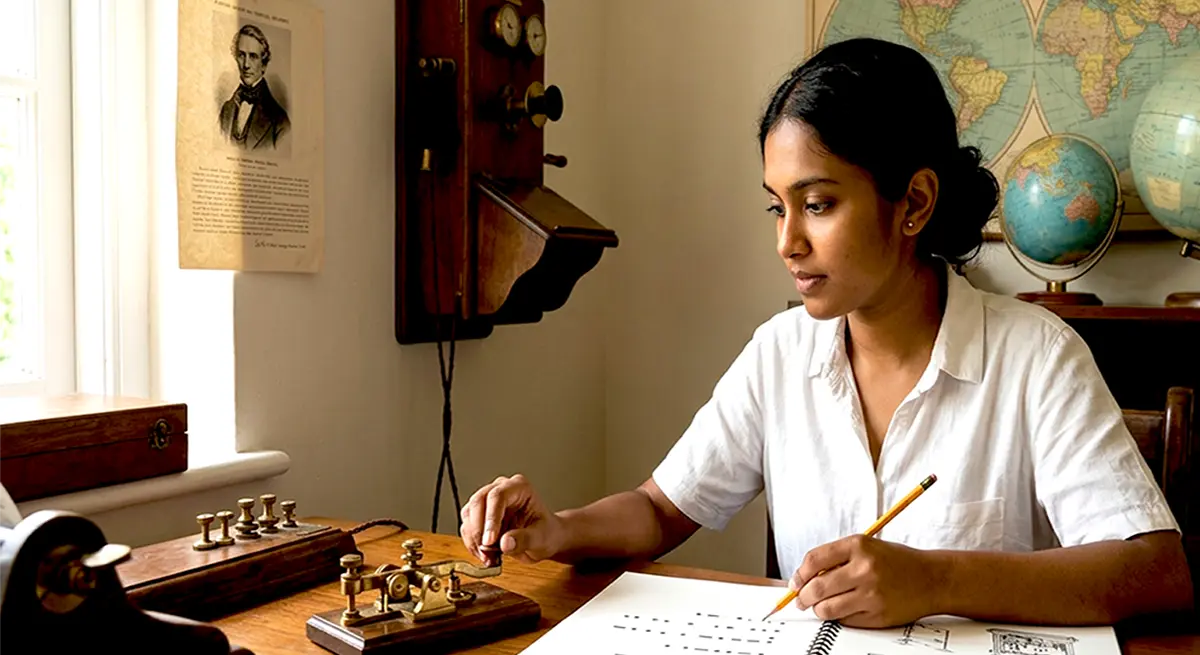
Samuel Finley Breese Morse— American artist and inventor (1791–1872) — in a notepad in 1836, sketched dots and dashes on paper. Among the ideas that would change the world was this one: an invention to encode messages over an electrical wire — a machine, the telegraph. In less than ten years that sketch turned into the first real telegraph network — and Morse's dots and dashes, created in partnership with Alfred Vail, became a standardized language for long-distance communication.
The Issue That Morse Was Trying to Solve
In the early 1800s, horses were used to rapidly convey news. The US didn't have a national telegraph network, or telephone, and radio. Battles, ship arrivals, and financial prices could take days or weeks to travel across the nation. Morse, a well-known portrait painter at the time, had personal reasons of his own: he discovered by letter that his wife had died — days after her funeral had already occurred.
That sorrow pushed him towards a means of communicating more expediently. Upon meeting physicist Charles Thomas Jackson on a voyage to England in 1832, Morse became interested in electromagnetism and began drawing plans for an electrical telegraph system.
Inventing the Code
Morse's original concept utilized numbers, not letters — a book of codes would convert each number to a word. It was Alfred Vail who suggested modelling the patterns one-to-one with letters of the alphabet, making it a far more usable system. Vail also optimized the key and sounder equipment. What emerged was American Morse Code, which they demonstrated publicly for the first time on January 6, 1838.
On May 24, 1844, the first long-distance message was sent from Washington, D.C., to Baltimore. Morse tapped out the text from the Bible: “What hath God wrought.”
Expansion and the First International Standard
In the 1850s, telegraph networks became established systems in Europe and North America. American Morse Code did create issues for international use: its characters were not great and tough to memorize. A simplified version created by Friedrich Clemens Gerke was standardised in 1865, and became the basis for radio telegraphy (now under the ITU). That became International Morse Code, which is the one used around the globe today, including by amateur radio operators.
The Transatlantic Cable
The transatlantic cable that was laid between Ireland and Newfoundland in 1858 represented the most ambitious telegraph project of all time. A 98-word message sent from Queen Victoria to President Buchanan took a grueling 16 hours — but Morse had shown that continents could be connected. A reliable cable finally succeeded in 1866.
Morse Code at Sea: SOS
One of the best-known uses for Morse code developed in maritime form: the distress signal SOS. The universal distress call SOS (··· −−− ···) was adopted by the Berlin International Wireless Telegraph Convention in 1906 — not because of what those letters spell, but instead for its recognizability through noise. In 1912, the sinking of the Titanic drew broad public interest in signals and established Morse code as a potentially life-saving tool.
World Wars and Morse Code
Both World Wars were largely fought with Morse code military communications. Operators became masters, able to send and receive 20–30 words per minute in Morse code. Messages in Morse, often further encrypted, were the orders directing troop movements, coordinating naval operations, and providing intelligence. The infamous German Enigma was used to encode messages in Morse prior to transmission.
The Radio Age
Morse code found a new medium when Guglielmo Marconi demonstrated wireless telegraphy in the 1890s. Early radio was wireless Morse — no voice, just dots and dashes. It was used by commercial radio stations, maritime fleets, and aviation. Up until well into the twentieth century, every ship's radio officer and commercial pilot had to be Morse-certified.
Decline and Preservation
Over time Morse code began to be replaced professionally by digital communication. In 1999, the Global Maritime Distress and Safety System (GMDSS) replaced maritime Morse. Morse code was formally abolished as a requirement for amateur radio operators by the ITU in 2003.
Yet Morse code never disappeared. It remains in active use by the amateur radio community (more than 700,000 licensed operators across the US). That is appreciated by emergency services because Morse signals cut through the electronic clutter of radio interference and tough conditions that foil voice communications. And as simple a medium as it may be, a flashlight or even blinks of an eye can convey it — which is why it's still part of military survival training today.
Morse Code Today
Morse code is not nearly on the way to being outdated, and it has adopted new lifeways as assistive technology. Morse code is used by people with motor disabilities to write on smartphones and computers. Google Gboard supports Morse input. Military forces still use Morse as part of their comms protocols. And every year millions of those who love to learn stumble upon it using online translators, apps, and practice games.
Two hundred years after Samuel Morse drew his first telegraph on a boat, dots and dashes are still one of the most elegant — one of the hardiest communications systems ever invented.